Glyphosate Remediation Product - Addressing the Negative Effects of GMOs
Is Your Feed Safe for Your Horse?
Glyphosate Contamination in Equine Rations
Share
It used to be that we could generally trust that the grains and forages we fed to our livestock were reasonably
safe, if not always of the same nutritional value.
That all changed with the advent of GMO technology, and we are now forced to question the safety of almost everything
we eat ourselves or feed to our animals.
The main culprit is glyphosate, the active ingredient in Monsanto’s RoundUp herbicide.
Most crops in the U.S. today, including corn, soybeans, beet pulp, molasses, corn syrup and alfalfa, are contaminated
with glyphosate residues.
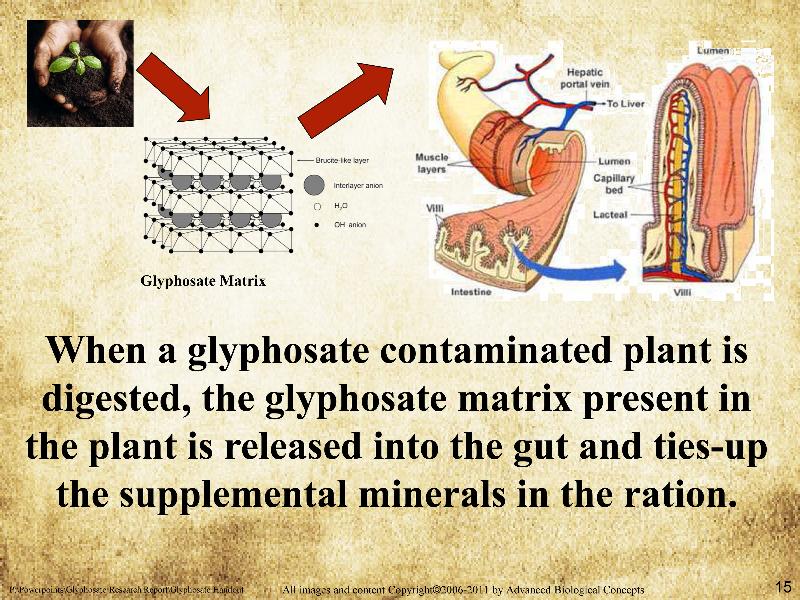
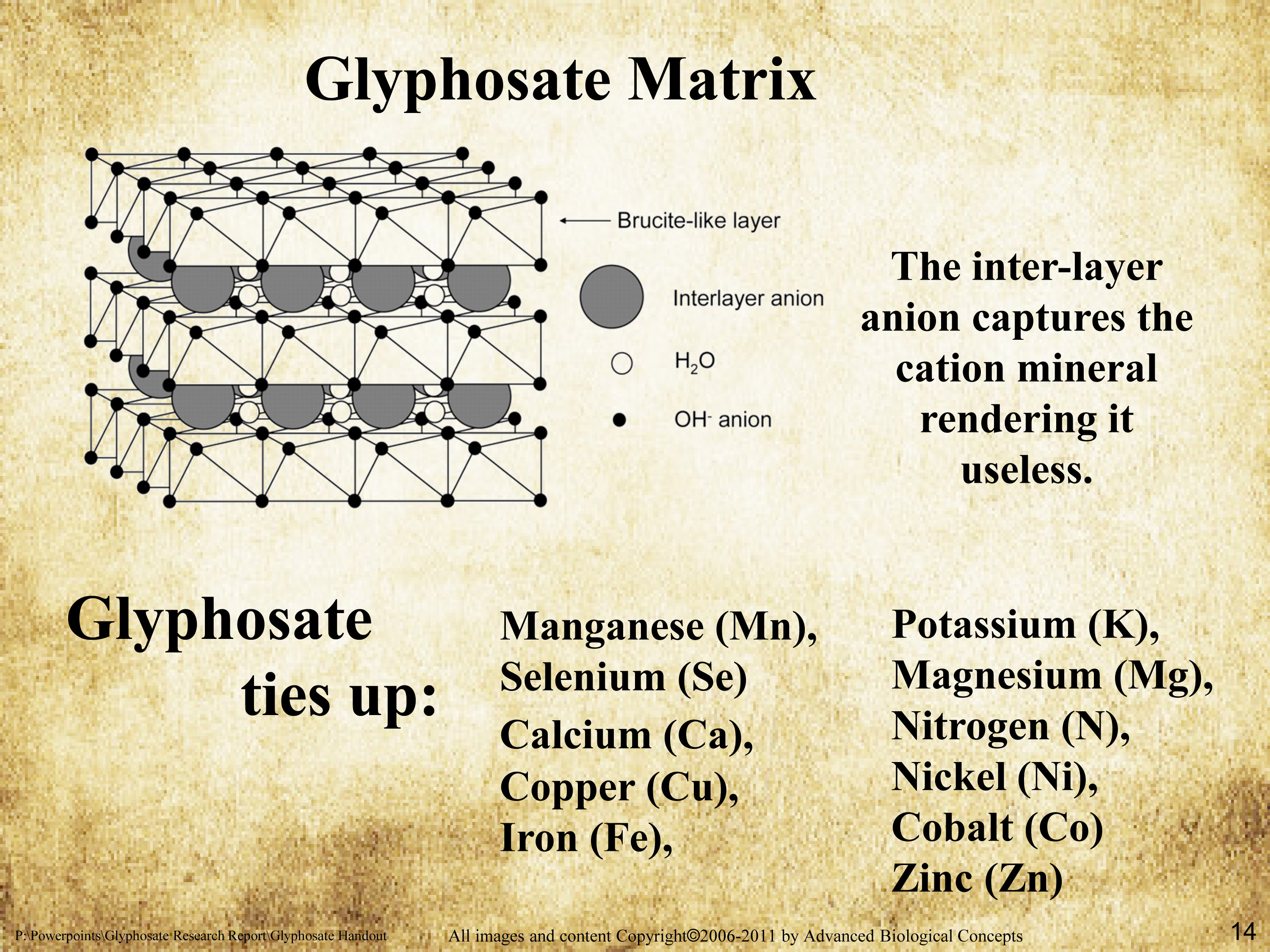
Glyphosate is a strong chelator.
When the glyphosate matrix ispresent in the gut, it captures and ties-up many essential trace minerals.
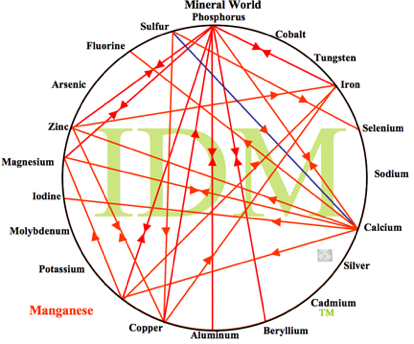
The Mineral World at left illustrates the critical inter-relationships between essential minerals and trace
minerals.
Glyphosate reduces the availability of Manganese - an element necessary for the functioning of Calcium and Phosphorus.
Calcium and Phosphorus, available and in proper balance, are essential to the utilization of the majority of the
other elements, as illustrated in the chart.
Glyphosate unbalances this wheel.
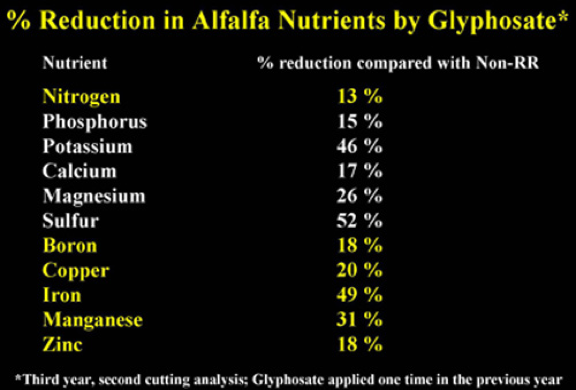
This chart represents the reduced mineral uptake in Alfalfa - Third year, second cutting analysis; Glyphosate applied one time in the previous year.
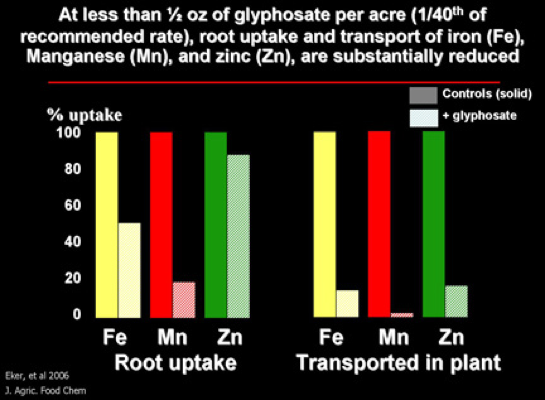
The chart at right shows the effects of glyphosate on the root uptake and transport in the plant,
of Iron, Manganese and Zinc when applied at 1/40 the recommended rate.
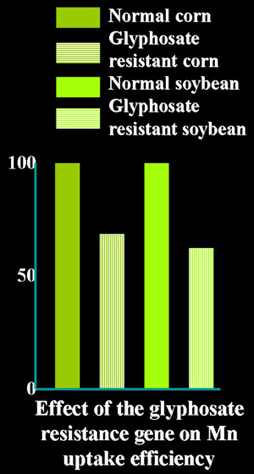
The chart at left represents
the reduced mineral uptake in GMO corn and soybean plants.
The use of Glyphosate on crops not only damages the health of plants and soil microbes, but also results in
feed crops that are nutritionally deficient as well as toxic.
Crops not treated with glyphosate but grown in contaminated fields can still harbor the chelation effects that
interfere with mineral metabolism and reduce nutritional value.
The resulting malnutrition sets the stage for all sorts of problems including immune suppression, inflammatory
conditions, gastro-intestinal problems, ulcers, diarrhea,
poor production and impaired reproduction. Not all animals are affected. The least fit or most stressed succumb
first.
Some health problems associated with glyphosate contamination:
Foreign proteins from GMOs stimulate allergic reactions.
As an example of the problem, here is a quote from Joyce Harman, DVM, which nicely sums up the situation: “I
think we have a huge new problem on the horizon with GMO beet pulp.
Motivated by a client who almost lost her horse, I did a bit of research and found a lot of other horses in different
areas had severe GI issues. And it all makes sense.
Her entire barn is doing fabulously now that she eliminated beet pulp, and she normally feeds well, conservatively
and not ever much grain, but was using beet pulp to get supplements into her horses.
The horse I was working on went from chronically sore, not great muscle or weight and a bit of a project (and I
knew he had ulcers, but did not do well on some herbs)
to soft, happy and in good weight, with good muscle in just a few months.”
GMOs are so widespread that the only way to avoid them is to feed only organic certified rations.
Advanced Biological Concepts’ cutting edge products are certified Organic, free of GMOs, and do not contain beet
pulp.
If your ration does contain glyphosates, we recommend feeding our new ABC’s Glyphosate Remediation™ Product.
A.B.C.’s G.R.P.™ -
Addressing the negative effects of GMOs
using Glyphosate Remediation Technology™
Click Here to View Product Information and to Order
Glyphosate Remediation Product - Addressing the Negative Effects of GMOs
Nutritional Supplement for all Classes of Horses
Most feed grains today are contaminated with GMOs and glyphosate - the active ingredient in Monsanto's RoundUp
herbicide.
Glyphosate contaminated feed can cause a variety of problems in horses, including GI problems, stiffness, lethargy,
and others.
It's almost impossible to avoid GMO's. Not only are they present in beet pulp but
also in grains, such as corn and soybeans,
as well as in alfalfa. The only way to avoid them is to feed only organic certified
rations.
We have GMO free, find under our GRAINS catagory.
This GRP product is to help those of you who still have to feed commerically bagged feeds found in your local farm
store.
Daily Top Dress Feeding Instructions per Horse:
Gestating Mares: 4 ounces or 2 scoops per day (114 g)
Lactating Mares: 4 ounces or 2 scoops per day (114 g)
Weanlings: 4 ounces or 2 scoops per day (114 g)
Yearlings: 4 ounces or 2 scoops per day (114 g)
Aged Horses: 4 to 8 ounces or 2 to 4 scoops per day (114 g)
Adult Horses: 4 ounces or 2 scoops per day (114 g)
Stallions: 4 ounces or 2 scoops per day (114 g)
Horses in Training: 4 ounces or 2 scoops per day (114 g)

 The chart at left represents
the reduced mineral uptake in GMO corn and soybean plants.
The chart at left represents
the reduced mineral uptake in GMO corn and soybean plants.